
Retail Lighting Design: How to Boost Sales with the Right Light
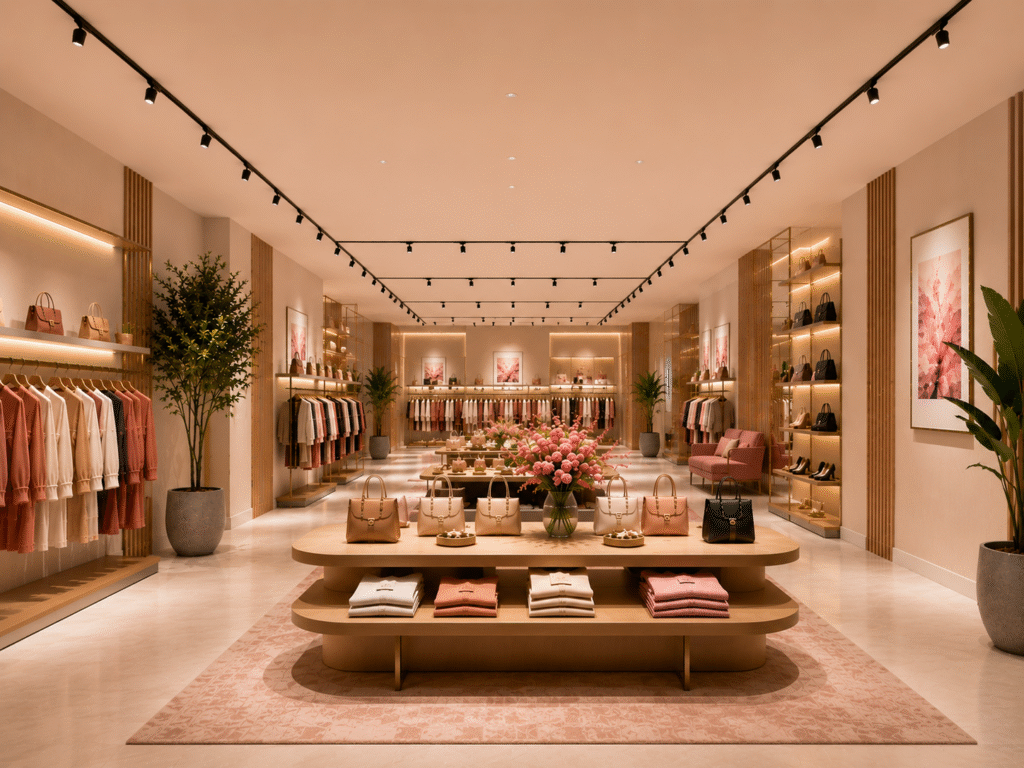
Walk into any successful retail store and you will immediately sense something that sets it apart from the competition. The products look more appealing. The space feels inviting. You want to stay longer, explore more, and buy more. In most cases, the secret weapon behind this experience is expertly designed retail lighting.
Retail lighting design is one of the most commercially impactful specialisms in architectural lighting. Done well, it directly influences customer behaviour, brand perception, and sales performance. In this guide, we explore how to use light strategically to boost sales and create unforgettable retail experiences.
Why Retail Lighting Design Matters
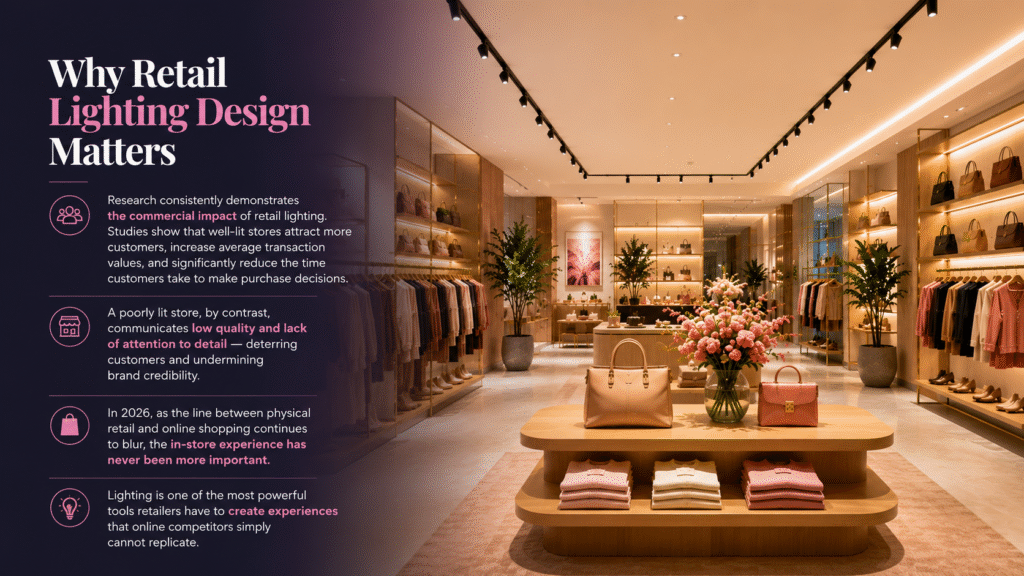
Research consistently demonstrates the commercial impact of retail lighting. Studies show that well-lit stores attract more customers, increase average transaction values, and significantly reduce the time customers take to make purchase decisions. A poorly lit store, by contrast, communicates low quality and lack of attention to detail — deterring customers and undermining brand credibility.
In 2026, as the line between physical retail and online shopping continues to blur, the in-store experience has never been more important. Lighting is one of the most powerful tools retailers have to create experiences that online competitors simply cannot replicate.
Key Principles of Retail Lighting Design
1. Hierarchy and Focus
The most effective retail lighting schemes create a clear hierarchy of light — drawing the customer’s eye to the most important products and areas of the store. High-contrast accent lighting on key merchandise creates focal points that guide customers through the space and draw attention to high-margin products, new arrivals, and promotional displays.
2. Colour Rendering
In retail environments, colour rendering is critical. Products must look their best under artificial light — which means using light sources with a high Colour Rendering Index (CRI), ideally 90 or above. Poor colour rendering makes food look unappetising, clothing look dull, and jewellery lose its sparkle. High-CRI LED lighting ensures that products look as vibrant and true-to-life as possible.
3. Colour Temperature
The colour temperature of light — measured in Kelvin — has a significant impact on how a retail environment feels and how products are perceived. Warm white light (2700K–3000K) creates an intimate, luxurious atmosphere ideal for jewellery, fashion, and premium lifestyle brands. Neutral white (3500K–4000K) is versatile and works well for mid-market retail. Cool white (5000K+) conveys precision and cleanliness, ideal for technology and automotive retail.
4. Layered Lighting
The best retail lighting schemes use multiple layers of light — ambient lighting for general visibility, accent lighting for product highlights, and feature lighting for architectural elements and brand moments. This layered approach creates depth, visual interest, and flexibility — allowing the lighting scheme to be adjusted for different seasons, promotions, and times of day.
5. Entrance and Window Display Lighting
The entrance and window display are a retailer’s most valuable marketing real estate. Lighting these areas brilliantly is essential for attracting footfall and communicating brand identity from the street. High-intensity directional lighting, dynamic colour effects, and dramatic contrast can transform a window display into a powerful brand statement that stops passers-by in their tracks.
6. Dwell Time and Atmosphere
Research shows that customers who spend more time in a store spend more money. Lighting that creates a comfortable, welcoming atmosphere — with warm tones, soft shadows, and flattering illumination — encourages customers to linger. Harsh, over-bright lighting has the opposite effect, creating discomfort and encouraging people to leave.
Retail Lighting by Sector
Fashion and Apparel
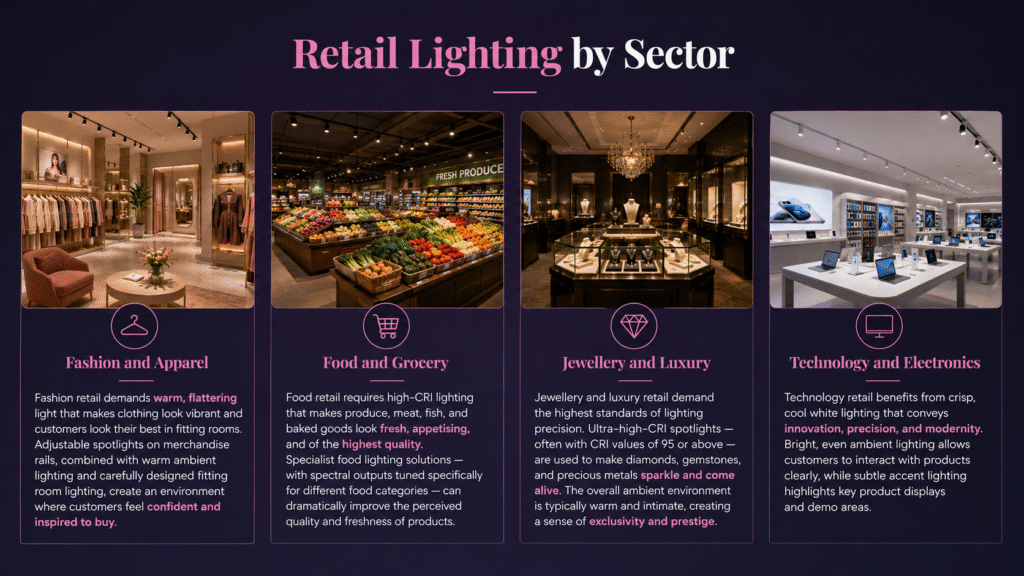
Fashion retail demands warm, flattering light that makes clothing look vibrant and customers look their best in fitting rooms. Adjustable spotlights on merchandise rails, combined with warm ambient lighting and carefully designed fitting room lighting, create an environment where customers feel confident and inspired to buy.
Food and Grocery
Food retail requires high-CRI lighting that makes produce, meat, fish, and baked goods look fresh, appetising, and of the highest quality. Specialist food lighting solutions — with spectral outputs tuned specifically for different food categories — can dramatically improve the perceived quality and freshness of products.
Jewellery and Luxury
Jewellery and luxury retail demand the highest standards of lighting precision. Ultra-high-CRI spotlights — often with CRI values of 95 or above — are used to make diamonds, gemstones, and precious metals sparkle and come alive. The overall ambient environment is typically warm and intimate, creating a sense of exclusivity and prestige.
Technology and Electronics
Technology retail benefits from crisp, cool white lighting that conveys innovation, precision, and modernity. Bright, even ambient lighting allows customers to interact with products clearly, while subtle accent lighting highlights key product displays and demo areas.
How Lumigraphics Supports Retail Lighting Projects
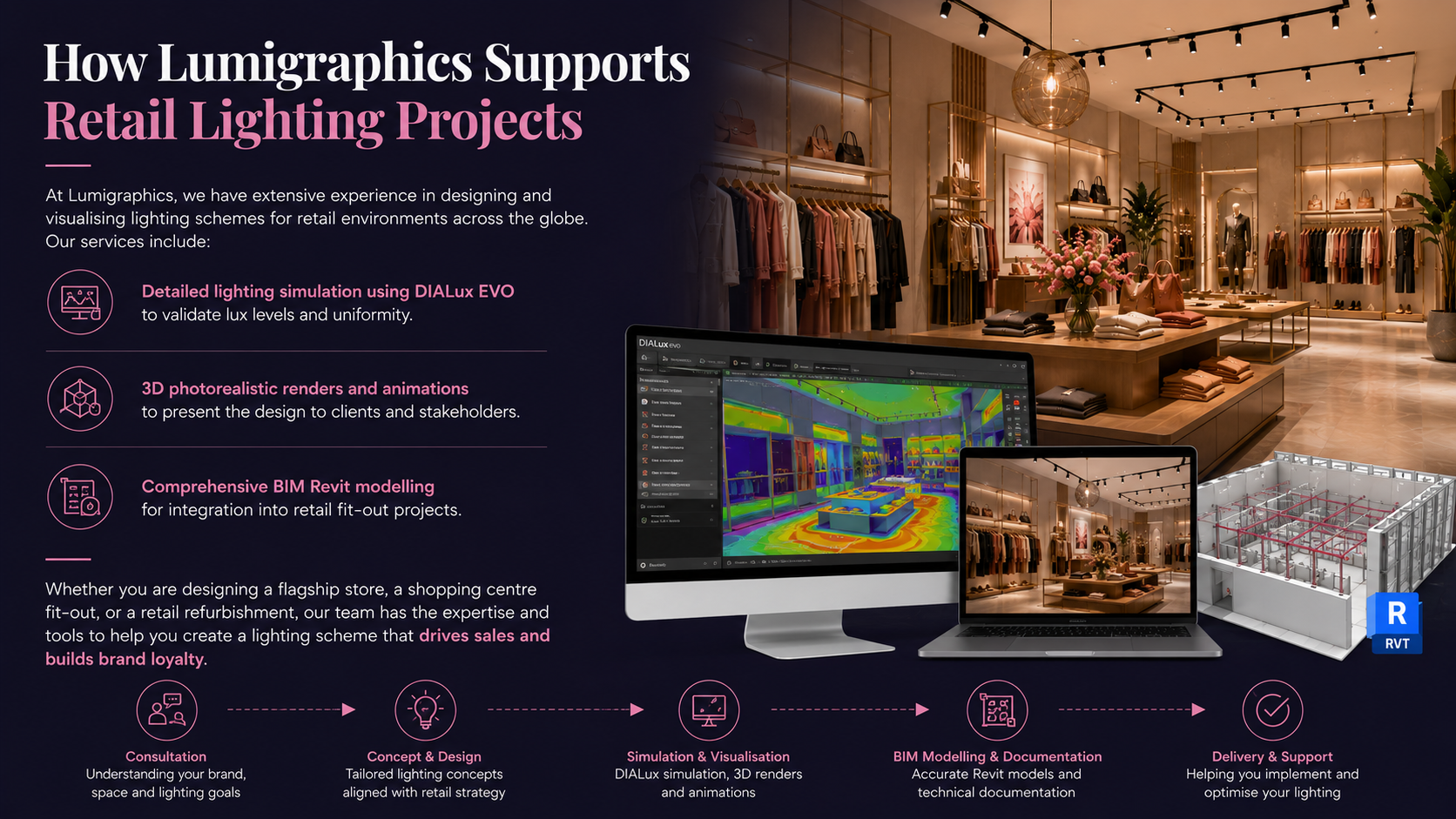
At Lumigraphics, we have extensive experience in designing and visualising lighting schemes for retail environments across the globe. Our services include detailed lighting simulation using DIALux EVO to validate lux levels and uniformity, 3D photorealistic renders and animations to present the design to clients and stakeholders, and comprehensive BIM Revit modelling for integration into retail fit-out projects.
Whether you are designing a flagship store, a shopping centre fit-out, or a retail refurbishment, our team has the expertise and tools to help you create a lighting scheme that drives sales and builds brand loyalty.
Conclusion
Retail lighting design is a powerful commercial tool that directly impacts customer behaviour, brand perception, and sales performance. In 2026, retailers that invest in professional lighting design are gaining a measurable competitive advantage over those that treat lighting as an afterthought.
Ready to transform your retail space with the power of light? Contact Lumigraphics today for expert retail lighting design and simulation services.