
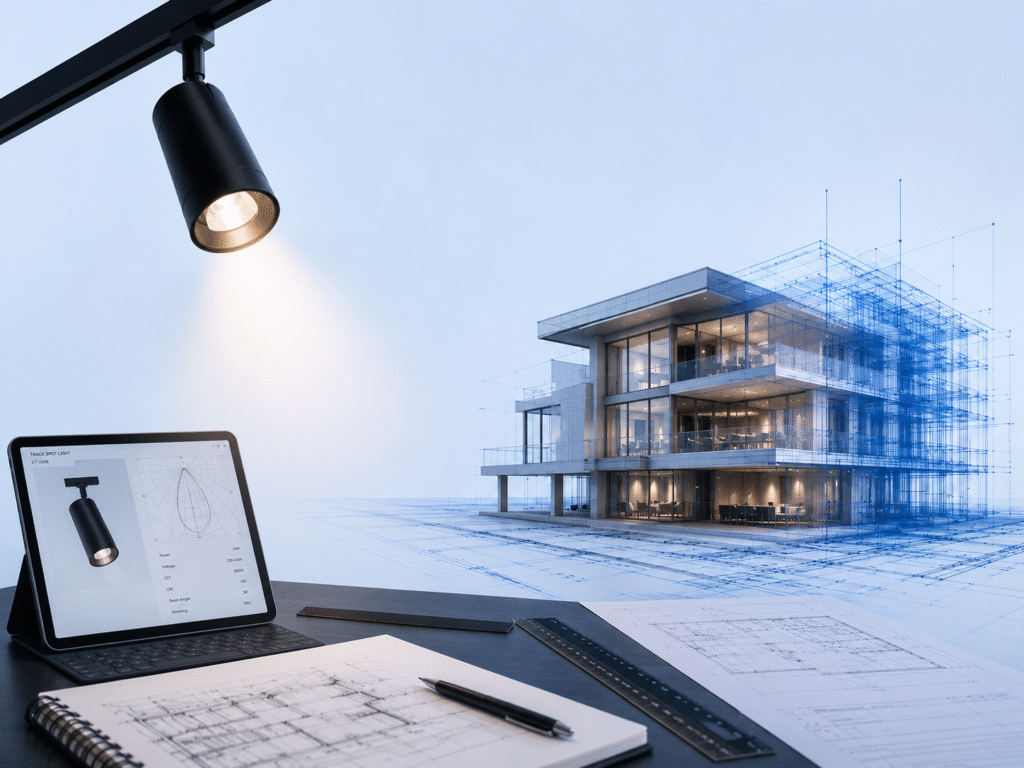
What is BIM and Why Is It Transforming Architectural Lighting Design?
Building Information Modelling — better known as BIM — has fundamentally changed the way buildings are designed, constructed, and managed. For the architectural lighting industry, BIM represents one of the most significant technological shifts in decades. In 2026, lighting designers, manufacturers, and distributors who understand and embrace BIM are gaining a decisive competitive advantage in the global marketplace.
In this guide, we explore what BIM is, how it applies specifically to architectural lighting, and why it is transforming the way the industry operates.
What is BIM?
Building Information Modelling is a digital process for creating and managing information about a building project across its entir lifecycle — from initial concept and design through construction, operation, and eventual decommissioning. A BIM model is far more than a 3D drawing. It is an intelligent, data-rich digital representation of a building that contains not just geometry, but a wealth of information about every component — materials, performance characteristics, cost data, maintenance schedules, and much more.
BIM is typically implemented using software platforms such as Autodesk Revit, ArchiCAD, or Bentley Systems, which allow architects, engineers, and contractors to collaborate on a shared digital model in real time.
How Does BIM Apply to Architectural Lighting?
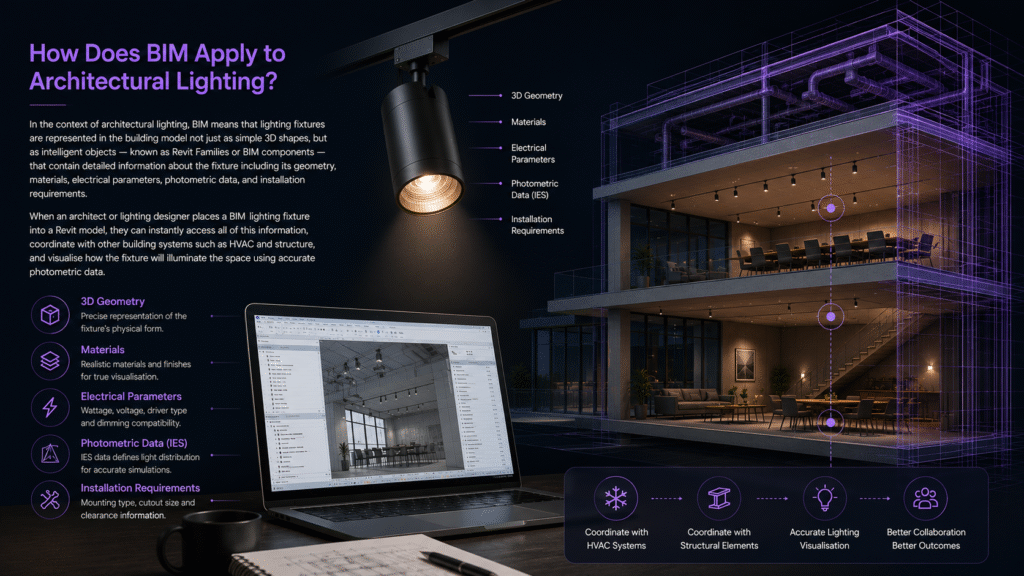
In the context of architectural lighting, BIM means that lighting fixtures are represented in the building model not just as simple 3D shapes, but as intelligent objects — known as Revit Families or BIM components — that contain detailed information about the fixture including its geometry, materials, electrical parameters, photometric data, and installation requirements.
When an architect or lighting designer places a BIM lighting fixture into a Revit model, they can instantly access all of this information, coordinate with other building systems such as HVAC and structure, and visualise how the fixture will illuminate the space using accurate photometric data.
Why is BIM Transforming Architectural Lighting Design?
1. Greater Design Accuracy
BIM lighting models allow designers to accurately represent fixtures in the context of the complete building model. This means lighting layouts can be coordinated precisely with ceiling structures, HVAC systems, and architectural elements — eliminating the clashes and coordination errors that frequently arise on site when lighting has been designed in isolation.
2. Faster and More Efficient Workflows
When lighting manufacturers provide high-quality Revit BIM files for their products, architects and lighting designers can import these directly into their models — saving hours of manual modelling time. This streamlines the design process and reduces the risk of errors associated with generic or inaccurate placeholder objects.
3. Improved Collaboration
BIM enables seamless collaboration between all members of the project team — architects, structural engineers, MEP consultants, lighting designers, and contractors. When all disciplines work from a shared BIM model, coordination is dramatically improved and costly on-site conflicts are significantly reduced.
4. Better Client Communication
The rich 3D visualisation capabilities of BIM platforms allow designers to produce compelling visual presentations of lighting schemes directly from the model — helping clients to understand and approve designs more quickly and confidently.
5. Support for Sustainability and Energy Modelling
BIM lighting models containing accurate electrical data — wattage, efficacy, dimming capabilities — can be integrated with building energy modelling tools to assess the energy performance of the lighting system and optimise designs for sustainability certifications such as LEED and BREEAM.
6. Competitive Advantage for Lighting Manufacturers
For lighting manufacturers and distributors, providing high-quality Revit BIM files for their products is increasingly a prerequisite for winning architectural specifications. Architects and lighting designers actively seek out manufacturers that offer comprehensive BIM libraries — and are more likely to specify products for which accurate BIM data is readily available.
What Should a Good Lighting Revit BIM File Contain?
A high-quality lighting Revit family should include the following:
Accurate 3D Geometry: A precise representation of the fixture’s physical form, based on manufacturer DWG drawings.
Material Definitions: Realistic materials that accurately represent the fixture’s finish — chrome, matte white, brushed gold, etc.
Photometric Data: Integrated IES file data that defines how the fixture distributes light — critical for accurate visualisation and simulation.
Electrical Parameters: Wattage, voltage, driver type, dimming compatibility, and other electrical specifications.
Manufacturer Information: Product name, model number, catalogue number, and URL for easy specification referencing.
Installation Parameters: Ceiling cutout dimensions, mounting requirements, and clearance specifications.
How Lumigraphics Creates World-Class BIM Revit Files
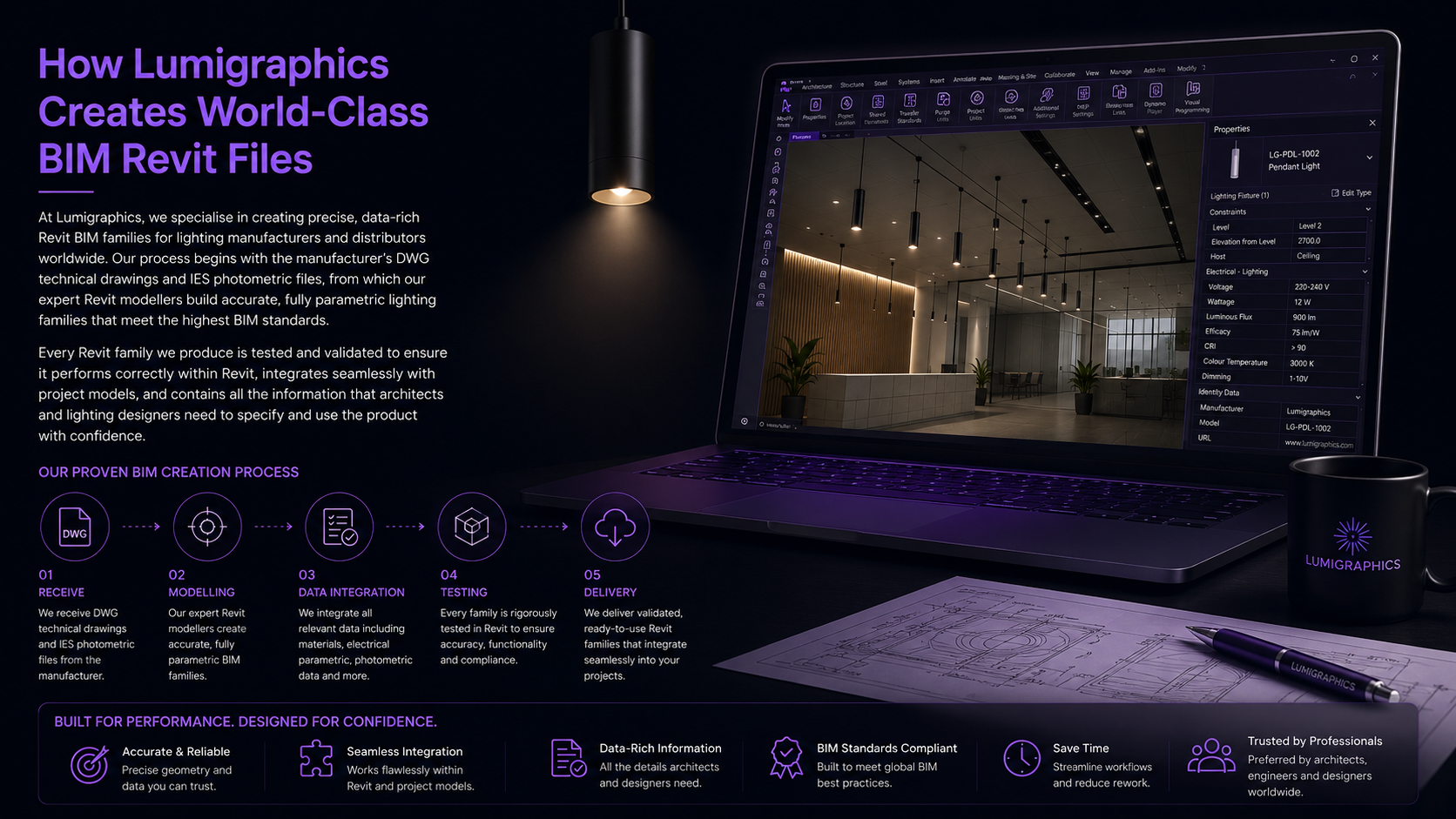
At Lumigraphics, we specialise in creating precise, data-rich Revit BIM families for lighting manufacturers and distributors worldwide. Our process begins with the manufacturer’s DWG technical drawings and IES photometric files, from which our expert Revit modellers build accurate, fully parametric lighting families that meet the highest BIM standards.
Every Revit family we produce is tested and validated to ensure it performs correctly within Revit, integrates seamlessly with project models, and contains all the information that architects and lighting designers need to specify and use the product with confidence.
Conclusion
BIM is not a passing trend — it is the future of the built environment industry, and architectural lighting is at the heart of that transformation. Whether you are a lighting designer looking to streamline your workflow, or a manufacturer seeking to win more architectural specifications, investing in high-quality BIM Revit files is one of the smartest decisions you can make in 2026.
Ready to create world-class BIM Revit files for your lighting products? Contact Lumigraphics today to get started.