
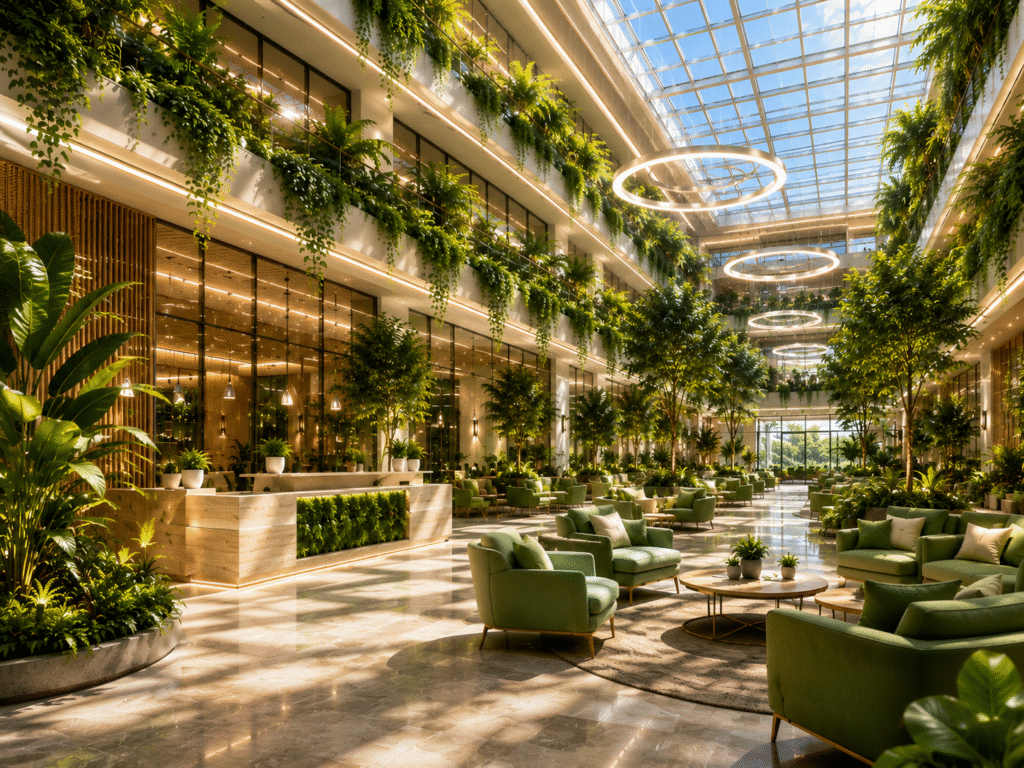
The Future of Sustainable Architectural Lighting in 2026
Sustainability has moved from the periphery to the very centre of architectural lighting design. As the global built environment industry responds to the urgent challenges of climate change, resource depletion, and human health, lighting designers are at the forefront of a transformation that is reshaping how buildings are illuminated — and how they perform environmentally, economically, and socially.
In 2026, sustainable architectural lighting is not a niche concern — it is the defining challenge and opportunity of our generation. Here is what the future looks like.
The Urgency of Sustainable Lighting Design
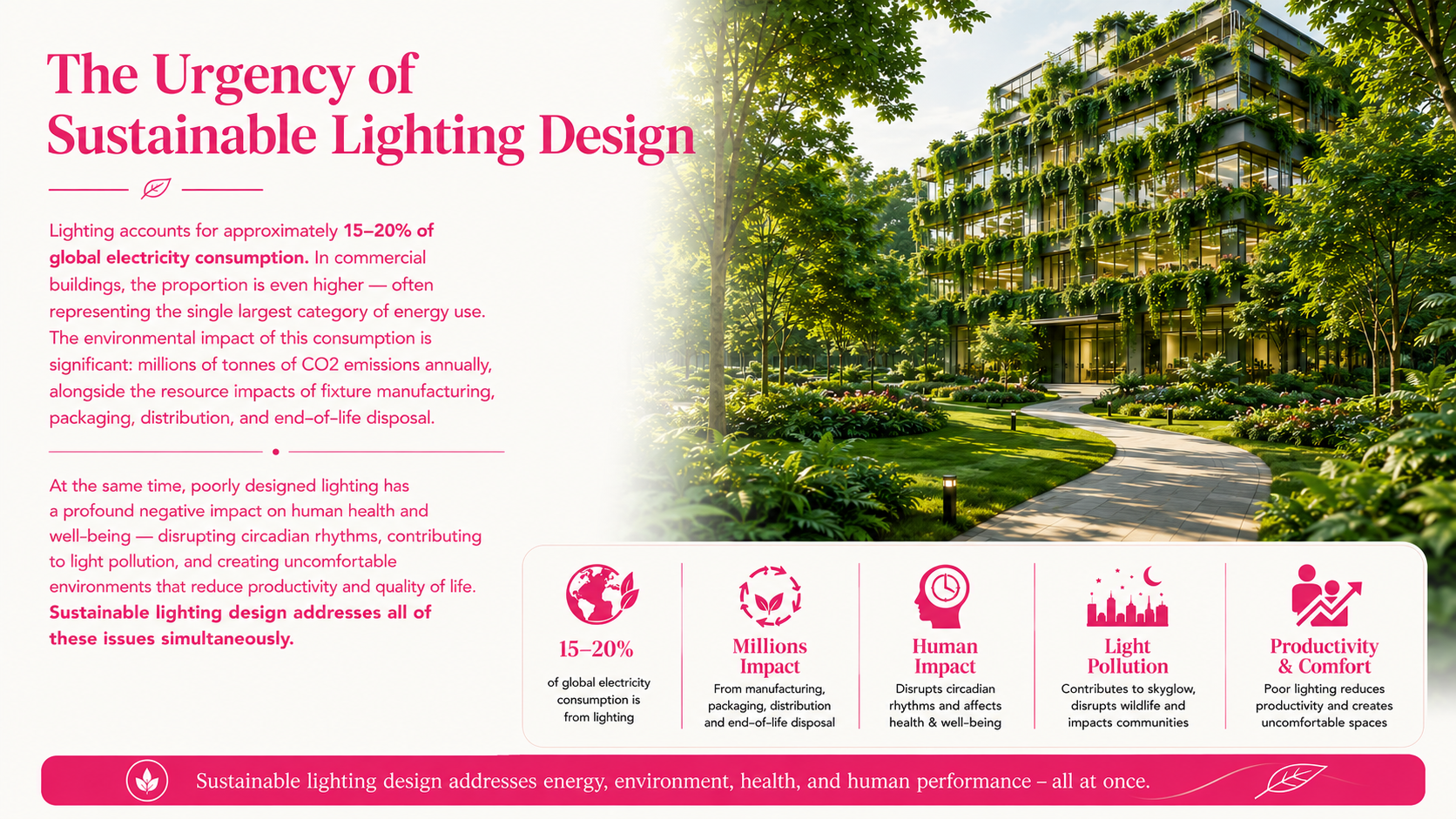
Lighting accounts for approximately 15–20% of global electricity consumption. In commercial buildings, the proportion is even higher — often representing the single largest category of energy use. The environmental impact of this consumption is significant: millions of tonnes of CO2 emissions annually, alongside the resource impacts of fixture manufacturing, packaging, distribution, and end-of-life disposal.
At the same time, poorly designed lighting has a profound negative impact on human health and well-being — disrupting circadian rhythms, contributing to light pollution, and creating uncomfortable environments that reduce productivity and quality of life. Sustainable lighting design addresses all of these issues simultaneously.
Key Pillars of Sustainable Architectural Lighting in 2026
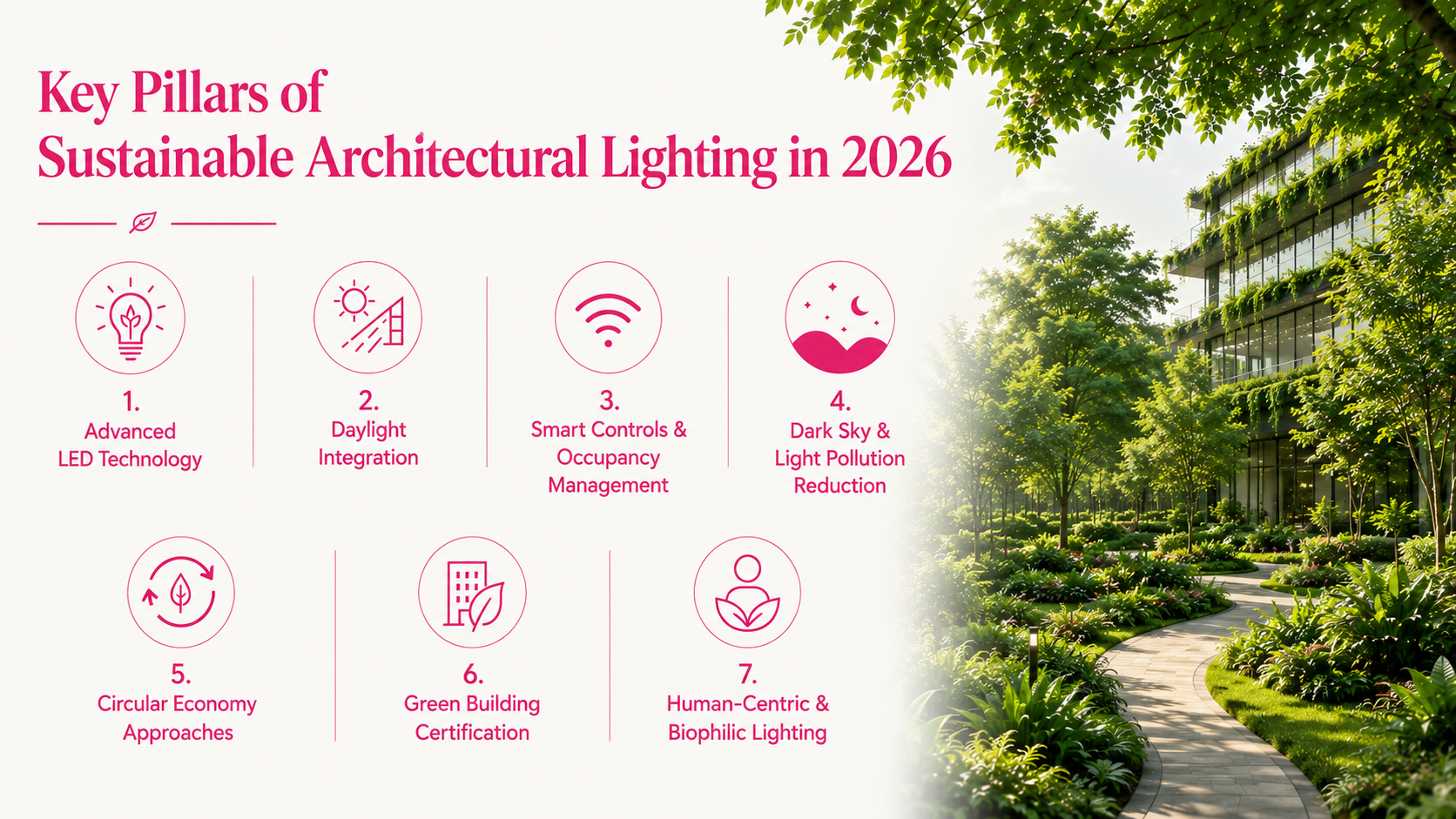
1. Advanced LED Technology
The LED revolution has transformed the energy efficiency of architectural lighting beyond recognition. In 2026, the latest generation of LED light sources are achieving efficacy levels of 200+ lumens per watt — compared to just 10–15 lumens per watt for the incandescent lamps they replaced. This 10–20x improvement in efficiency, combined with dramatically longer lifespans of 50,000–100,000 hours, makes LED technology the cornerstone of every sustainable lighting design.
2. Daylight Integration
One of the most effective sustainable lighting strategies is reducing the demand for artificial light in the first place. Daylight harvesting — using photosensors to automatically dim artificial lighting in response to available natural light — can reduce lighting energy consumption by 30–60% in buildings with good daylighting potential. Integrating daylight strategies into the early stages of architectural design, through careful building orientation, glazing specification, and internal layout planning, maximises this opportunity.
3. Smart Controls and Occupancy Management
Even the most efficient light source wastes energy if it is illuminating empty spaces. Smart occupancy sensors, time scheduling, and AI-driven lighting management systems ensure that lighting is only active when and where it is needed. In commercial buildings, these systems typically deliver energy savings of 20–40% on top of the efficiency gains from LED sources alone.
4. Dark Sky and Light Pollution Reduction
Artificial light at night — particularly poorly directed outdoor and facade lighting — is a major and growing source of environmental harm. Light pollution disrupts the behaviour of nocturnal wildlife, affects human sleep patterns, and obscures the night sky. In 2026, responsible lighting designers specify dark-sky-friendly fixtures with full cutoff optics that direct light precisely where it is needed, minimising spill, glare, and upward light emission.
5. Circular Economy Approaches
The circular economy — designing products and systems to eliminate waste and keep materials in use — is increasingly influencing how lighting products are designed, specified, and managed. In 2026, leading lighting manufacturers are offering modular, repairable, and recyclable fixtures with replaceable components, extended warranties, and take-back programmes. Specifying products that support circular economy principles reduces the environmental impact of the lighting installation over its full lifecycle.
6. Green Building Certification
Green building certification schemes — including LEED, BREEAM, WELL, EDGE, and Green Star — provide a structured framework for sustainable lighting design. These schemes reward designs that achieve high energy efficiency, good daylighting, glare control, and human-centric performance — and increasingly, the most ambitious projects are targeting multiple certifications simultaneously. Understanding and designing for these certification requirements is a core competency for lighting professionals in 2026.
7. Human-Centric and Biophilic Lighting
Sustainable lighting is not just about reducing energy consumption — it is also about improving human health and well-being. Human-centric lighting systems that support circadian health, biophilic designs that reconnect occupants with natural light patterns, and glare-free environments that reduce visual fatigue are all recognised as essential components of sustainable, healthy buildings in 2026.
How Lumigraphics Supports Sustainable Lighting Design
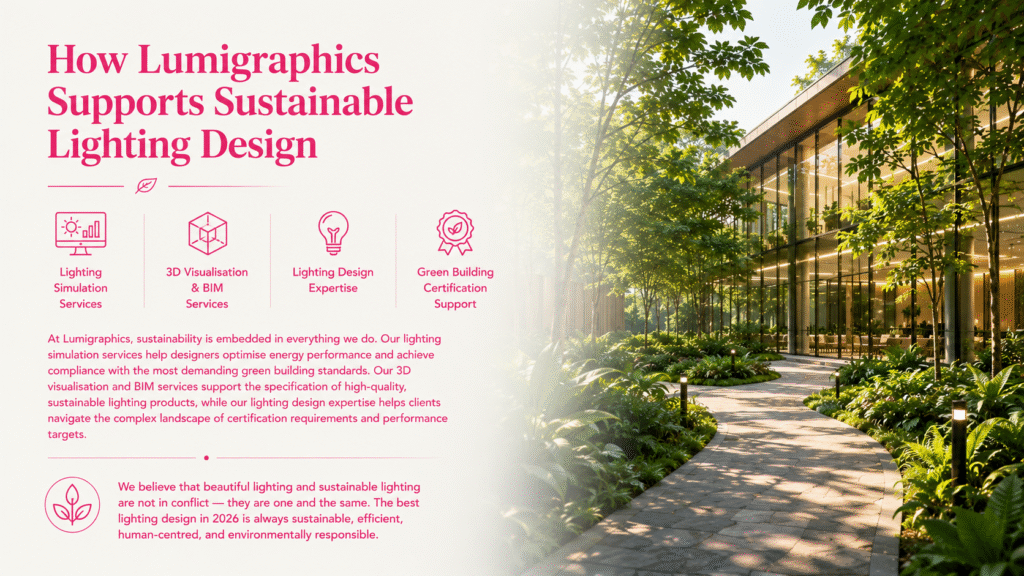
At Lumigraphics, sustainability is embedded in everything we do. Our lighting simulation services help designers optimise energy performance and achieve compliance with the most demanding green building standards. Our 3D visualisation and BIM services support the specification of high-quality, sustainable lighting products, while our lighting design expertise helps clients navigate the complex landscape of certification requirements and performance targets.
We believe that beautiful lighting and sustainable lighting are not in conflict — they are one and the same. The best lighting design in 2026 is always sustainable, efficient, human-centred, and environmentally responsible.
Conclusion
The future of sustainable architectural lighting in 2026 is bright — in every sense. Advances in technology, design practice, and regulatory frameworks are converging to create a built environment that is more energy-efficient, more human-centred, and more respectful of the natural world than ever before. For lighting designers, manufacturers, and building owners, this is not just a challenge — it is one of the most exciting opportunities in the history of the profession.
Want to ensure your next project is at the forefront of sustainable lighting design? Contact Lumigraphics today for expert guidance and support.