
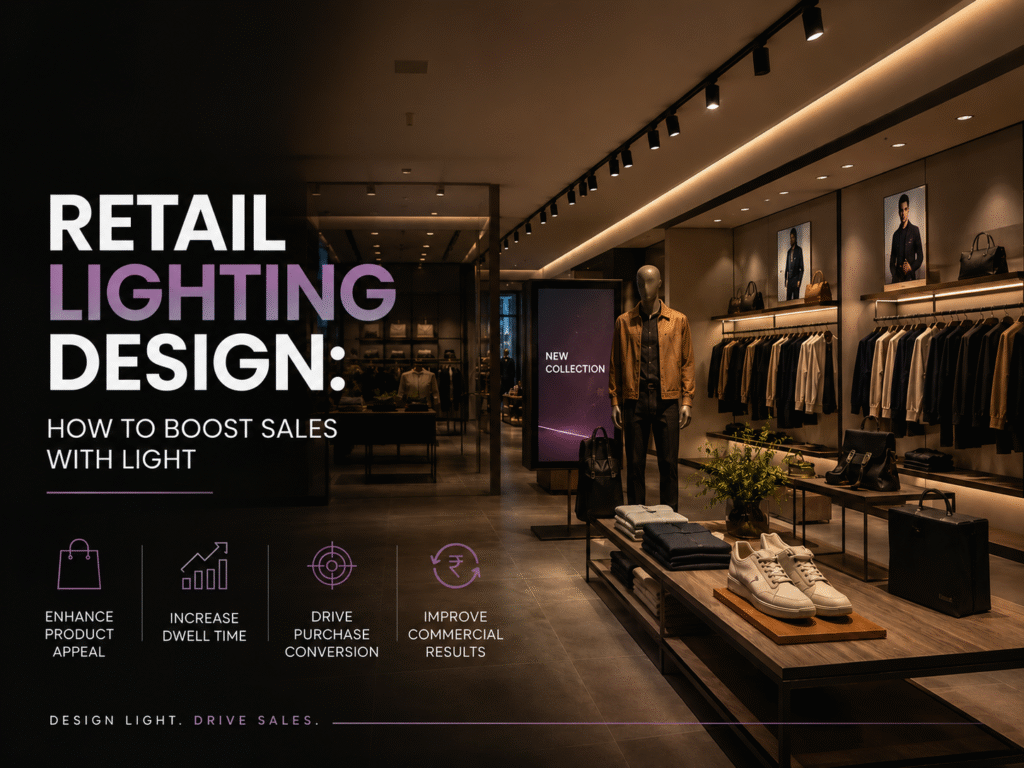
Retail Lighting Design: How to Boost Sales with Light
In retail environments, lighting is not a utility — it is a sales tool. Research consistently shows that well-designed retail lighting increases dwell time, product appeal, and purchase conversion. Getting it wrong has a measurable commercial cost.
The Science: What the Research Shows
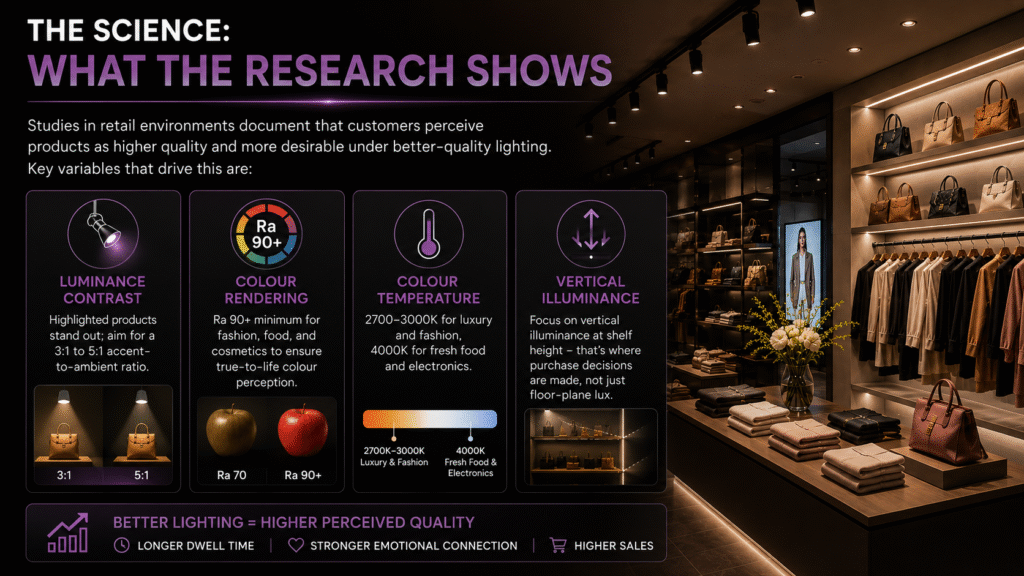
Studies in retail environments document that customers perceive products as higher quality and more desirable under better-quality lighting. Key variables that drive this are luminance contrast (highlighted products stand out; aim for a 3:1 to 5:1 accent-to-ambient ratio), colour rendering (Ra 90+ minimum for fashion, food, and cosmetics), colour temperature (2700–3000K for luxury and fashion, 4000K for fresh food and electronics), and vertical illuminance at shelf height rather than just floor-plane lux.
Zoning Strategy
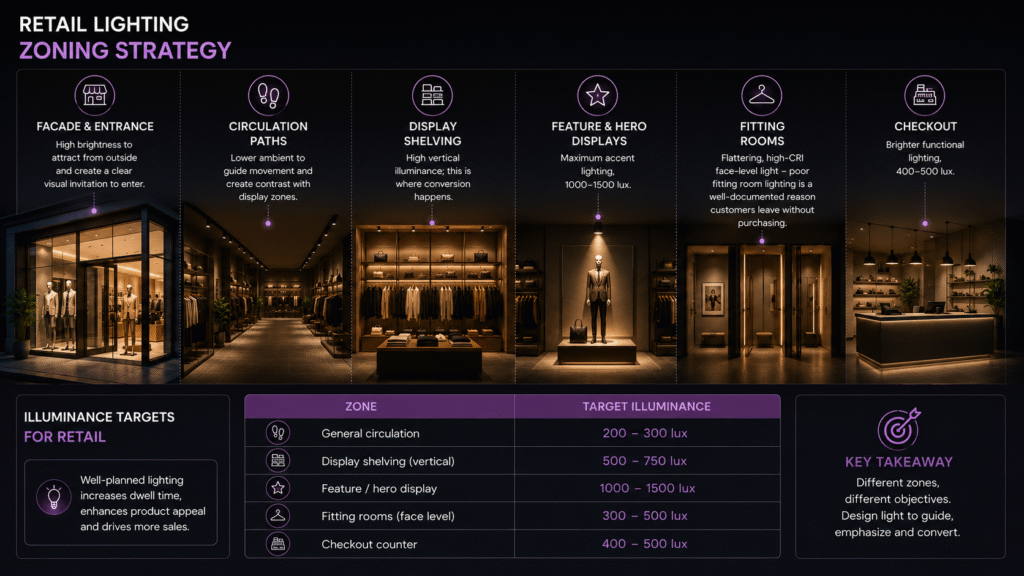
Effective retail lighting treats the store as distinct zones with different lighting objectives:
- Facade and entrance: High brightness to attract from outside and create a clear visual invitation to enter
- Circulation paths: Lower ambient to guide movement and create contrast with display zones
- Display shelving: High vertical illuminance; this is where conversion happens
- Feature and hero product displays: Maximum accent lighting, 1000–1500 lux
- Fitting rooms: Flattering, high-CRI face-level light — poor fitting room lighting is a well-documented reason customers leave without purchasing
- Checkout: Brighter functional lighting, 400–500 lux
Illuminance Targets for Retail
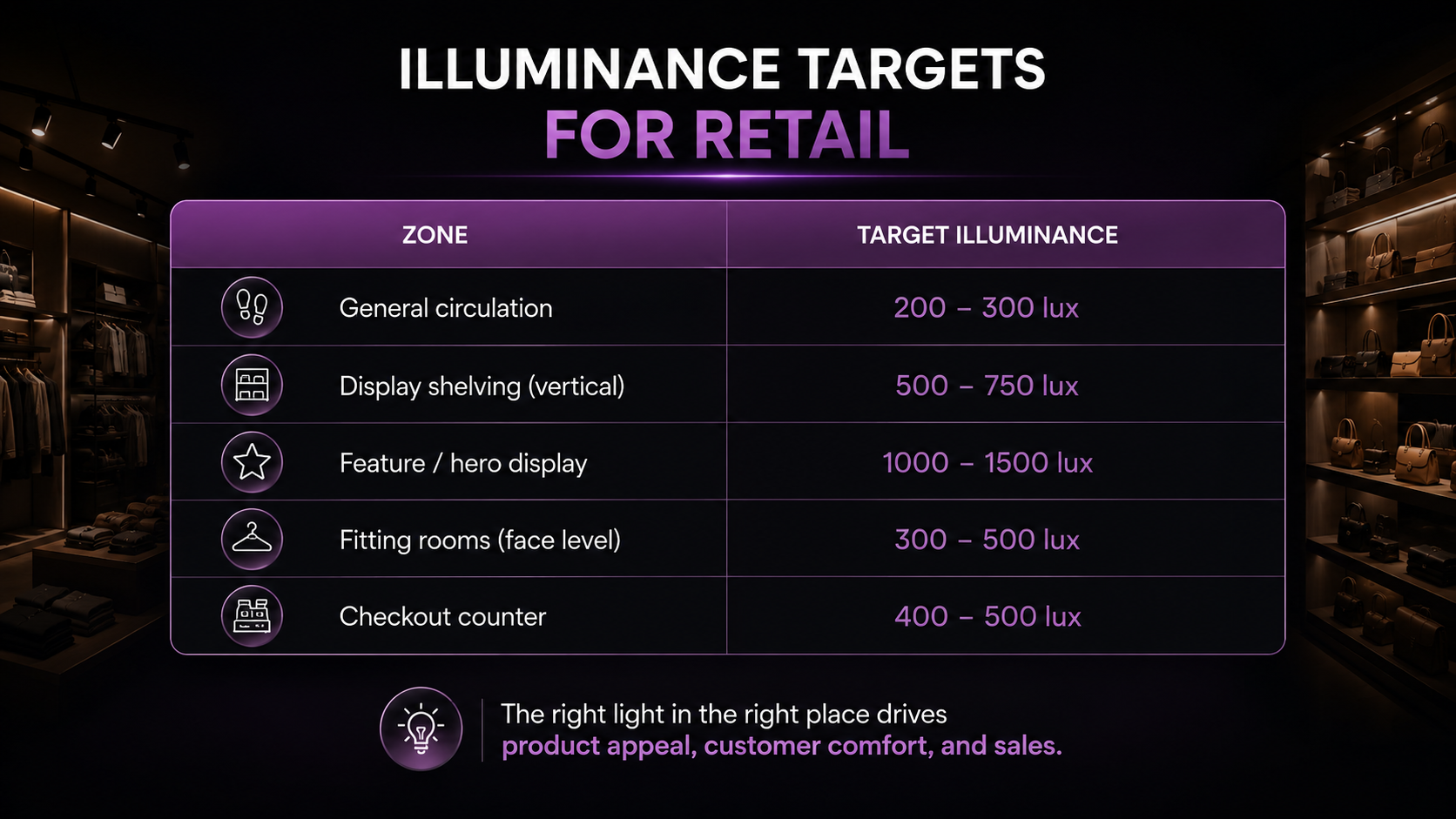
| Zone | Target Illuminance |
|---|---|
| General circulation | 200–300 lux |
| Display shelving (vertical) | 500–750 lux |
| Feature / hero display | 1000–1500 lux |
| Fitting rooms (face level) | 300–500 lux |
| Checkout counter | 400–500 lux |
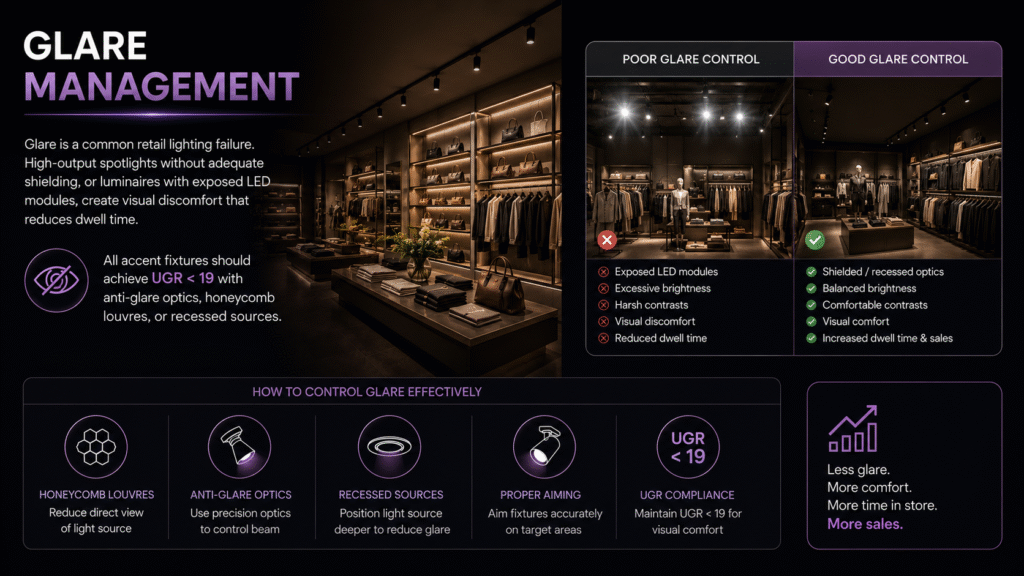
Glare Management
Glare is a common retail lighting failure. High-output spotlights without adequate shielding, or luminaires with exposed LED modules, create visual discomfort that reduces dwell time. All accent fixtures should achieve UGR < 19 with anti-glare optics, honeycomb louvres, or recessed sources.
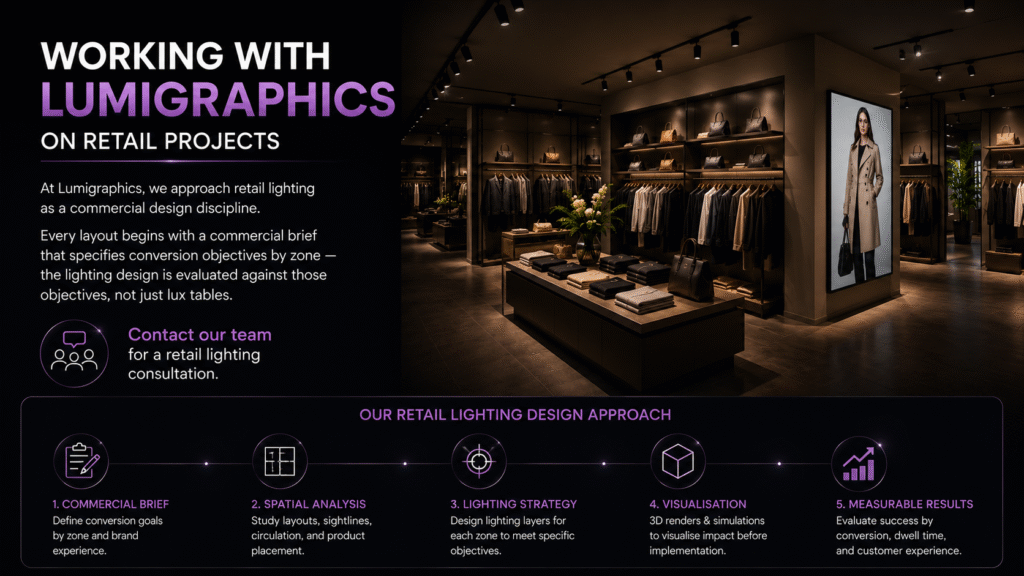
Working with Lumigraphics on Retail Projects
At Lumigraphics, we approach retail lighting as a commercial design discipline. Every layout begins with a commercial brief that specifies conversion objectives by zone — the lighting design is evaluated against those objectives, not just lux tables. Contact our team for a retail lighting consultation.