
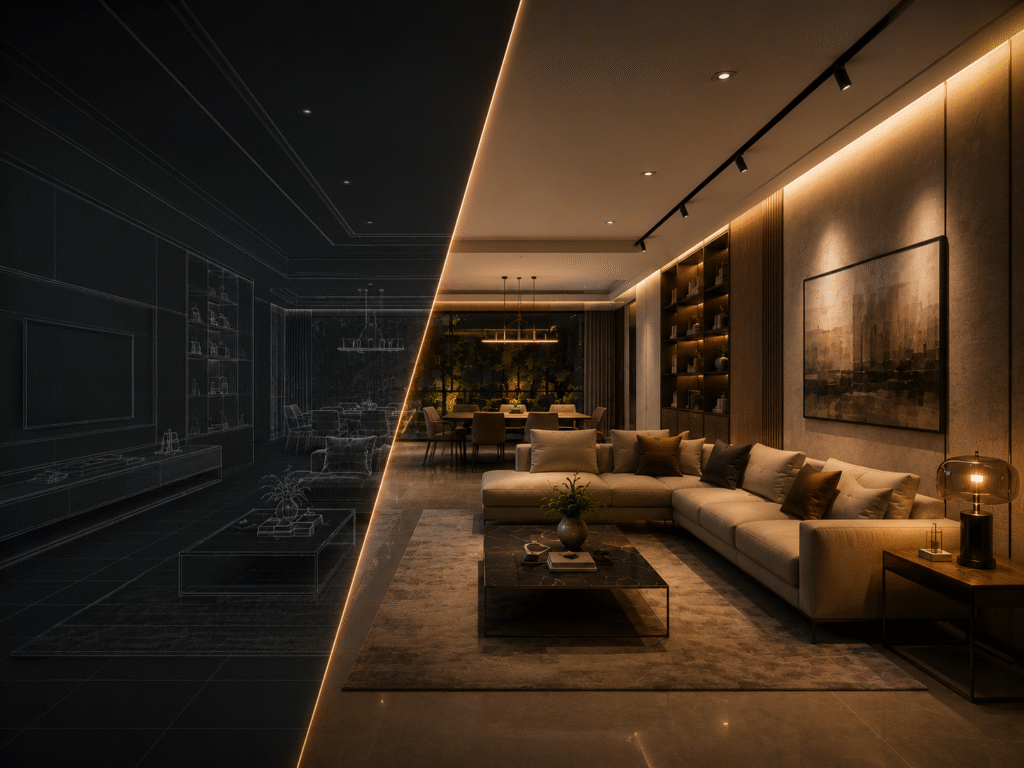
How 3D Renders Help Clients Visualise Lighting Before Installation
One of the most common challenges in architectural lighting projects is the gap between what a client imagines and what a designer intends. Words and technical drawings only go so far. This is why 3D lighting renders have become an essential communication tool for lighting designers — and why Lumengraphix uses them at the heart of every client engagement.
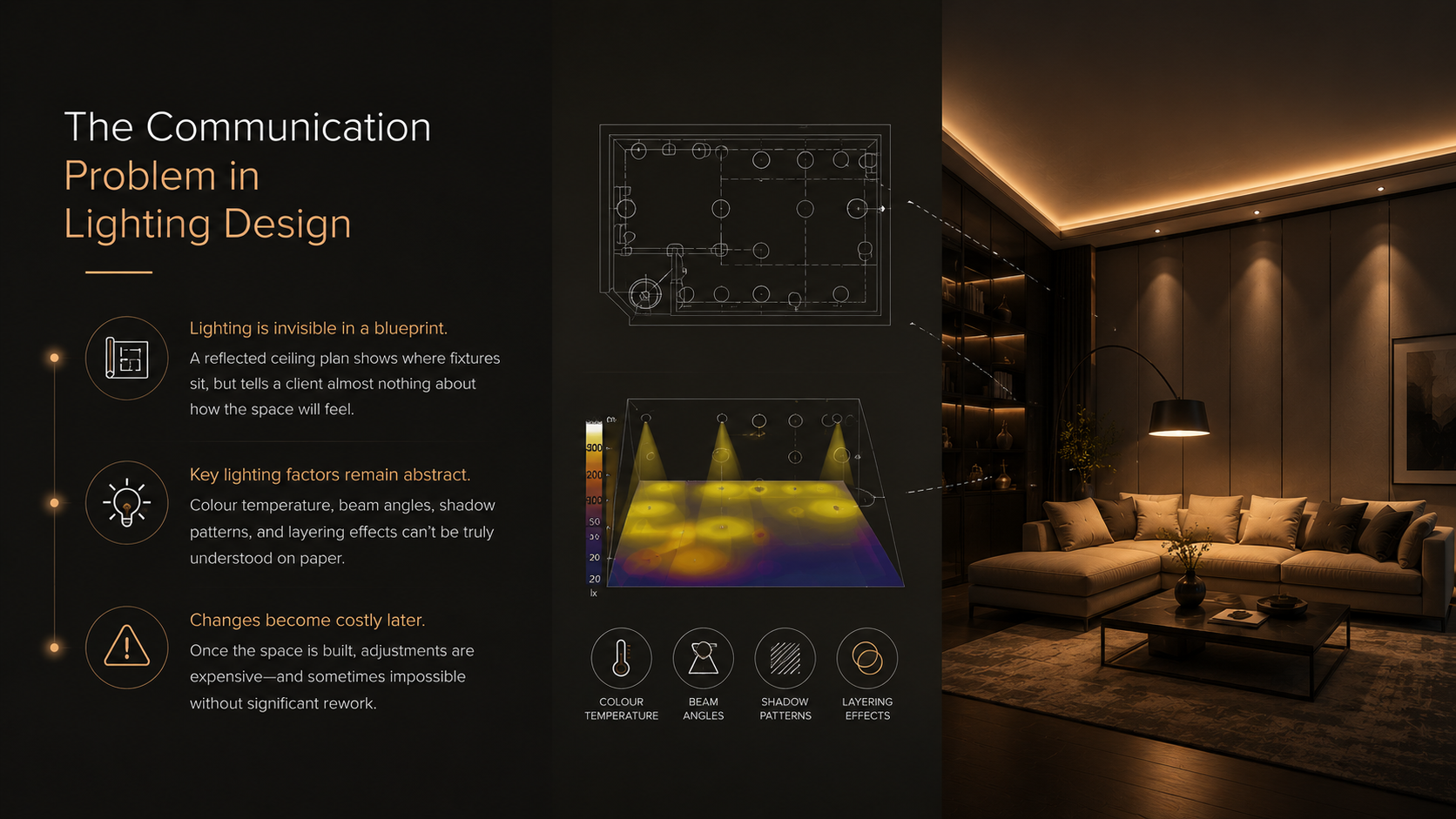
The Communication Problem in Lighting Design
Lighting is invisible in a blueprint. A reflected ceiling plan tells a trained designer where fixtures sit, but it tells a client almost nothing about how the finished space will feel. Colour temperature, beam angles, shadow patterns, and layering effects all remain abstract until the space is built. By that point, changes are expensive — and sometimes impossible without significant rework.
What 3D Lighting Renders Show That Plans Cannot
A photorealistic 3D render produced by Lumigraphics shows clients exactly how light will fall across surfaces, how shadows will form, and how the overall atmosphere of a room will present at different times of day or night. Clients can see warm versus cool colour temperatures side by side, compare accent lighting options, and experience the visual impact of different fixture placements — all before a single cable is run.
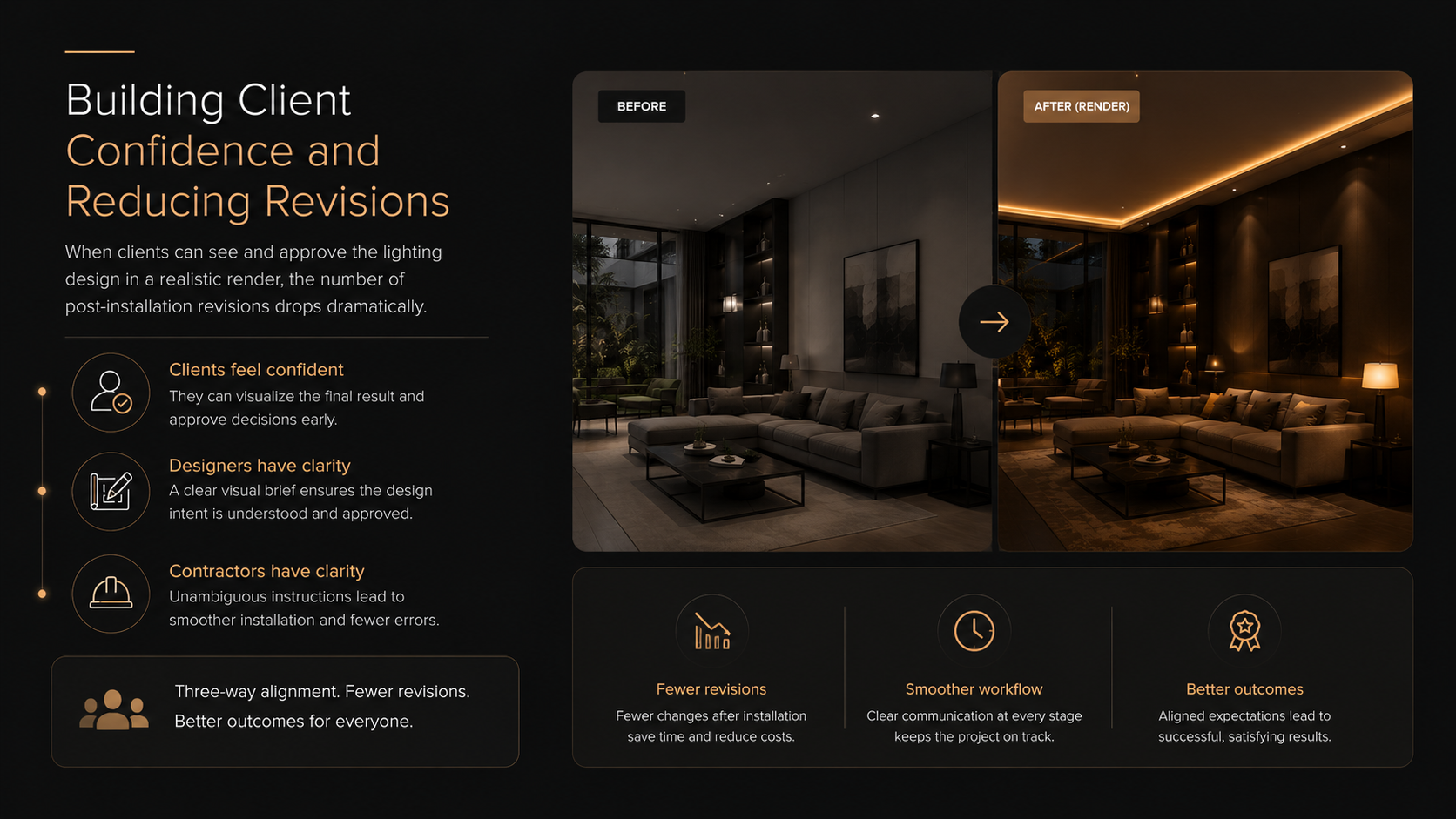
Building Client Confidence and Reducing Revisions
When clients can see and approve the lighting design in a realistic render, the number of post-installation revisions drops dramatically. Clients feel confident in their decisions, designers have a clear brief to execute, and contractors have unambiguous instructions. This three-way alignment is one of the most significant value-adds that 3D renders bring to the project workflow.
The Lumigraphics Rendering Process
At Lumigraphics, our 3D lighting renders are built from accurate photometric data, real fixture specifications, and properly modelled surface materials. We do not produce generic artistic impressions — every render is engineered to reflect how the lighting system will actually perform. This means what clients see in the render is what they get in the finished space.
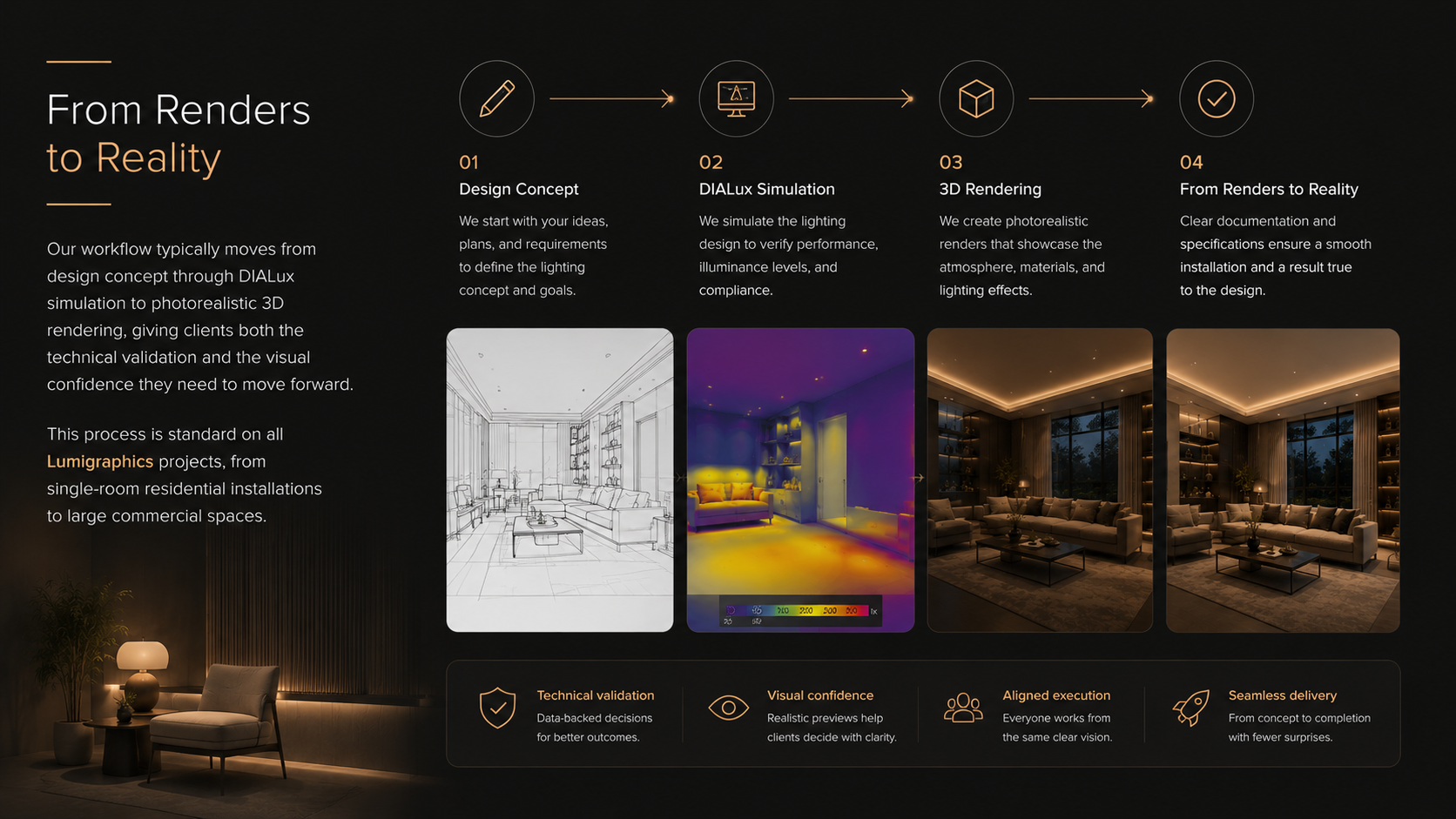
From Renders to Reality
Our workflow typically moves from design concept through DIALux simulation to photorealistic 3D rendering, giving clients both the technical validation and the visual confidence they need to move forward. This process is standard on all Lumigraphics projects, from single-room residential installations to large commercial spaces.
Want to see how your next lighting project will look before installation? Speak with the Lumigraphics team about our 3D rendering services today.