Introduction
In today’s commercial retail environments, lighting does far more than just illuminate a space—it directly influences customer experience, product perception, and overall store ambiance.
As customer expectations continue to rise, creating a comfortable and visually appealing environment has become essential. One key factor that defines lighting comfort is UGR (Unified Glare Rating).
Choosing lighting with UGR < 19 helps create a balanced, glare-free environment that enhances both visual comfort and retail performance.
What is UGR?
UGR (Unified Glare Rating) is a standard used to measure the level of discomfort caused by glare from a light source.
Glare occurs when lighting is too bright or harsh, making it difficult to see clearly and causing visual strain.
- Lower UGR value = Less glare, more comfort
- Higher UGR value = More glare, more discomfort
This makes UGR an essential consideration when designing lighting for retail spaces.
UGR Rating Guide for Visual Comfort
Advantages of UGR < 19 in Retail Spaces
1. Enhanced Visual Comfort
Retail spaces are designed for prolonged customer engagement.
UGR < 19 lighting provides soft, uniform illumination, reducing eye strain and ensuring a comfortable browsing experience.
2. Improved Product Visibility
Glare-free lighting enhances color accuracy, texture, and detail, allowing products to be displayed in their best light—helping customers make confident decisions.
3. Increased Customer Dwell Time
A comfortable lighting environment encourages customers to stay longer and explore more, which can positively impact sales.
4. Better Staff Productivity
Retail staff spend long hours under artificial lighting.
Low-glare lighting reduces fatigue and helps maintain focus, efficiency, and comfort throughout the day.
5. Premium Store Ambiance
Lighting with controlled glare contributes to a clean, modern, and high-end look, elevating the overall brand perception.
UGR Defines Visual Comfort.
Why UGR Matters for Architects & Lighting Designers
For professionals working on commercial projects, UGR is not just a comfort metric—it’s a design and specification requirement. better comfort, stronger visual appeal, and improved business performance.
- Ensures compliance with global lighting standards
- Strengthens design proposals and client presentations
- Reduces risk of post-installation complaints
- Enhances project quality and long-term performance
UGR vs Other Lighting Metrics
While UGR is crucial for controlling glare, a successful retail lighting design depends on balancing multiple lighting parameters. Each metric plays a unique role in shaping both visual comfort and product perception.
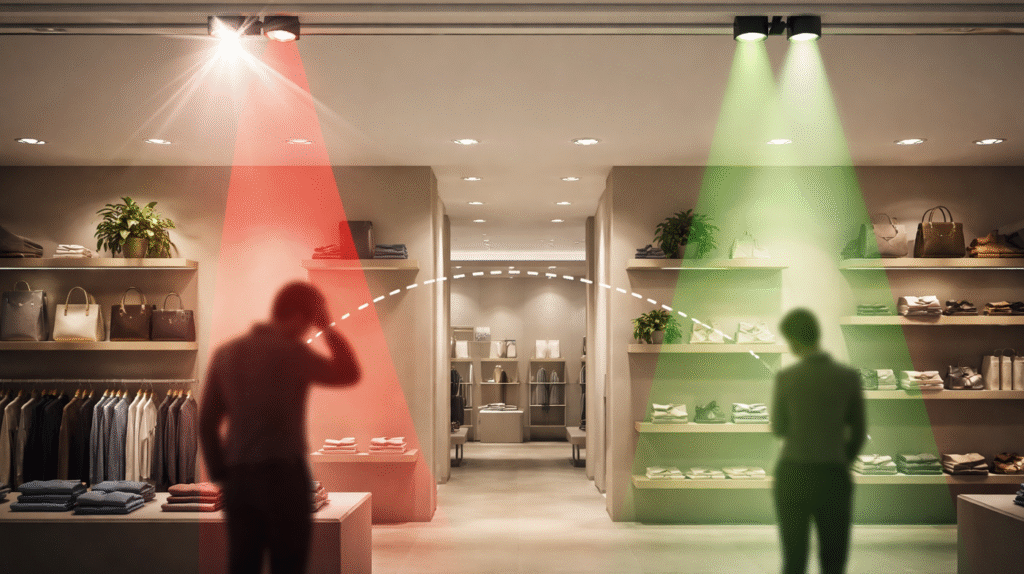
Zone of Glare
Comparison Overview
| Metric | Purpose | Why It Matters in Retail |
|---|---|---|
| UGR | Measures glare | Prevents discomfort and improves visual clarity |
| Lux Level | Measures brightness | Ensures products are well-lit and visible |
| CRI | Measures color accuracy | Displays true product colors and textures |
| CCT | Defines light color (warm/cool) | Creates the right mood and brand atmosphere |
Conculsion
Choosing UGR < 19 lighting is more than just meeting a technical requirement—it is a strategic decision that directly influences how a retail space performs. From customer comfort to product perception, glare control plays a crucial role in shaping the overall experience. In commercial retail environments, where first impressions matter, lighting must do more than illuminate—it must guide attention, enhance products, and create a welcoming atmosphere.
By implementing low-glare lighting, you create a visually comfortable environment that encourages customers to stay longer, improve product clarity and attractiveness to support better purchase decisions, enhance overall brand perception by delivering a more premium and professional look, support employee well-being and productivity during long operating hours, and reduce the risk of visual fatigue and customer dissatisfaction.
FAQs
Unified Glare Rating (UGR) is a standardized method used to measure the level of glare produced by a lighting system in an indoor environment. It calculates how uncomfortable the light appears to the human eye based on luminaire brightness, room size, and viewing angle. The lower the UGR value, the more visually comfortable the lighting environment will be. Designers use UGR to ensure lighting does not cause discomfort to users. It is commonly used in offices, retail stores, schools, and healthcare facilities.
UGR is important because glare directly affects human comfort, visibility, and productivity. When glare is too high, people may experience eye strain, headaches, and visual fatigue over time. In work environments like offices and retail stores, this can reduce productivity and negatively affect customer experience. Proper glare control improves visual comfort and helps create a more pleasant environment. This is why lighting designers always consider UGR during the planning stage.
Typical recommended UGR values:
- UGR < 19 → Offices, Retail, Showrooms
- UGR < 16 → Technical drawing rooms
- UGR < 13 → Hospitals, Laboratories
Lower UGR = Less glare = More comfort.
If UGR is too high, the lighting will produce discomfort glare that makes it difficult for people to see clearly. This can cause eye strain, headaches, and fatigue, especially in spaces where people spend long hours. In retail environments, high glare can make spaces feel harsh and uncomfortable, reducing the time customers spend in the store. In offices, it can reduce employee concentration and productivity. Over time, poor glare control can negatively impact both health and performance.

Glare can be reduced by:
- Using anti-glare optics
- Using deep recessed lighting
- Using diffusers
- Proper fixture placement
- Lower brightness contrast
Yes, UGR is very important in retail lighting because it directly affects customer comfort and shopping experience. If the lighting creates too much glare, customers may feel uncomfortable and leave the store sooner. Comfortable lighting encourages customers to stay longer and interact more with products. It also improves product visibility without creating harsh reflections. That is why most retail lighting designs aim for UGR < 19.
Glare is the visual sensation caused by excessive brightness in the field of view, which leads to discomfort. UGR, on the other hand, is a numerical value used to measure and predict glare in a space. In simple terms, glare is what people feel, while UGR is what designers calculate. UGR helps standardize glare control in lighting design. This makes it easier to design comfortable lighting environments for different applications.
Lighting is not just about visibility, it is about creating an experience.
Thomas E. Farin
- All
- 3D Lighting Product Rendering
- Architectural Lighting Design
- Lighting Design
- Lighting Design Services
Why Choose UGR < 19 Lighting for Commercial Retail Spaces?
The Role of Lighting in Architecture
Lighting 3D Rendering & Animation Trends Shaping Product Marketing in 2026
From Concept to Certainty: The Role of Lighting Simulation
How Early Lighting Wireframes Reduce Design Revisions & Project Delays?