
What is Architectural Lighting Design? A Complete Guide for 2026
Architectural lighting design is one of the most powerful — and most underestimated — tools in the built environment. Whether you are an architect, interior designer, property developer, or business owner, understanding how light shapes space is essential to creating environments that are not only functional but emotionally resonant, visually stunning, and energy efficient.
In this complete guide, we explore what architectural lighting design is, why it matters more than ever in 2026, and how professional lighting design services can transform any space — from a luxury hotel lobby to a bustling retail store or a serene residential home.
What is Architectural Lighting Design?
Architectural lighting design is the art and science of planning, designing, and implementing lighting systems within and around buildings. It goes far beyond simply selecting light fixtures. It involves a deep understanding of how light interacts with architecture, materials, human perception, and emotion.
At its core, architectural lighting design combines three essential disciplines: technical knowledge of photometrics and electrical systems, creative vision for aesthetics and atmosphere, and human-centred thinking that prioritises the well-being and experience of the people who inhabit a space.
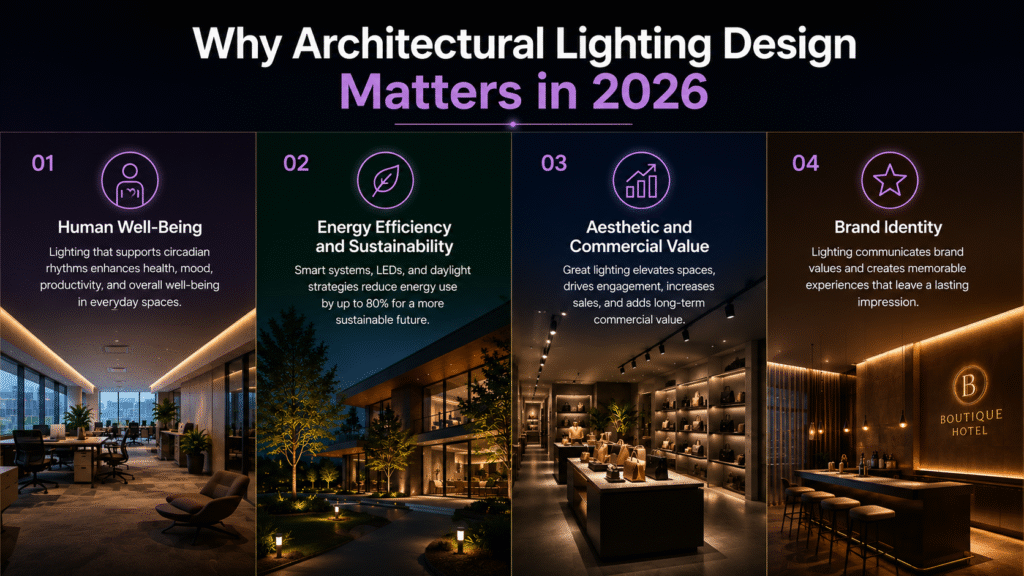
Why Architectural Lighting Design Matters in 2026
In 2026, lighting design has never been more important. Here is why:
1. Human Well-Being
Research has consistently shown that light has a profound impact on human health, mood, productivity, and sleep. Human-centric lighting design — which aligns artificial light with the body’s natural circadian rhythms — is now a standard consideration in office buildings, hospitals, schools, and residential developments.
2. Energy Efficiency and Sustainability
With global sustainability targets becoming more stringent, lighting design plays a critical role in reducing a building’s energy consumption. Smart lighting systems, LED technology, and daylight integration strategies can reduce lighting energy use by up to 80% compared to conventional systems.
3. Aesthetic and Commercial Value
Great lighting design dramatically enhances the visual appeal of any space — and with it, the commercial value. Studies show that well-lit retail environments increase dwell time and sales. Beautifully lit hospitality spaces command higher rates and stronger guest reviews. Thoughtfully lit residential developments attract premium buyers.
4. Brand Identity
For commercial clients, lighting is a powerful branding tool. The colour temperature, intensity, and direction of light in a space communicate brand values — whether that is the clinical precision of a tech company’s headquarters or the warm, intimate ambiance of a boutique hotel.
The Three Layers of Architectural Lighting
Every successful architectural lighting scheme is built on three fundamental layers:
Ambient Lighting
Ambient lighting provides the general, overall illumination of a space. It sets the base level of light that allows people to move safely and comfortably. In architectural design, ambient light is often delivered through recessed downlights, ceiling-mounted fixtures, cove lighting, or large-format luminaires.
Task Lighting
Task lighting provides focused illumination for specific activities — reading, cooking, working, or examining products. In offices, this might be desk lamps or under-cabinet lighting. In retail, it could be directional spotlights illuminating merchandise displays.
Accent Lighting
Accent lighting highlights specific architectural features, artwork, or objects of interest. It creates depth, drama, and visual interest in a space. Techniques include wall washing, grazing, uplighting, and spotlighting.
Key Principles of Architectural Lighting Design
Professional lighting designers follow a set of core principles to achieve outstanding results:
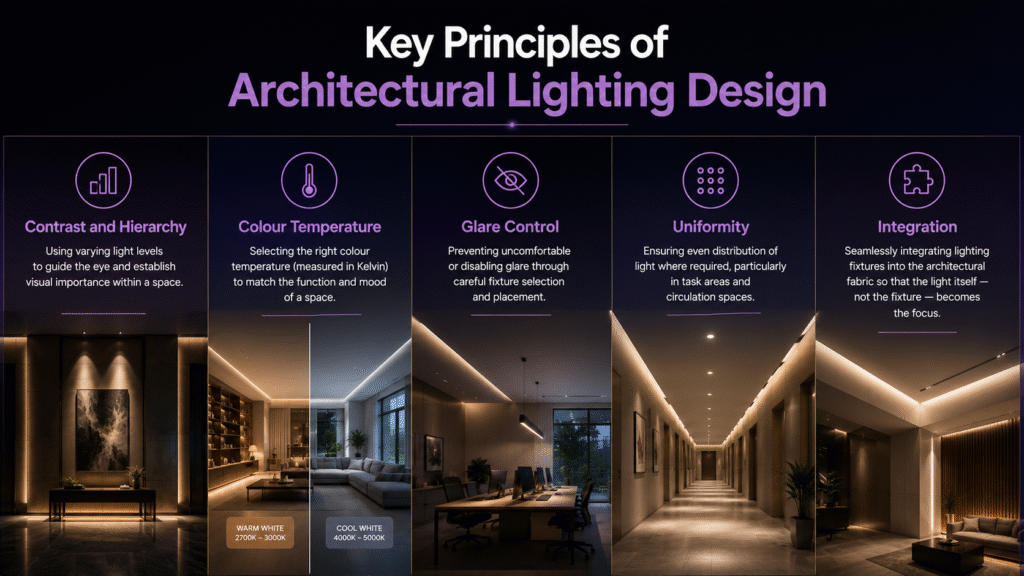
- Contrast and Hierarchy: Using varying light levels to guide the eye and establish visual importance within a space.
- Colour Temperature: Selecting the right colour temperature (measured in Kelvin) to match the function and mood of a space — warm whites for hospitality and residential, cooler whites for offices and retail.
- Glare Control: Preventing uncomfortable or disabling glare through careful fixture selection and placement.
- Uniformity: Ensuring even distribution of light where required, particularly in task areas and circulation spaces.
- Integration: Seamlessly integrating lighting fixtures into the architectural fabric so that the light itself — not the fixture — becomes the focus.
The Architectural Lighting Design Process
A professional architectural lighting design project follows a structured process:
- Briefing and Consultation: Understanding the client’s vision, functional requirements, budget, and project timeline.
- Concept Design: Developing a lighting concept that defines the overall direction — the mood, colour palette, key focal points, and lighting layers.
- Schematic Design: Translating the concept into preliminary lighting layouts and fixture selections.
- Lighting Simulation: Using professional software such as DIALux EVO to model and validate the lighting design — checking lux levels, uniformity, and glare before anything is installed.
- Design Development: Refining the design based on simulation results and client feedback, producing detailed specifications and bill of quantities.
- Construction Documentation: Preparing lighting plans, schedules, and specifications for contractors and electricians.
- Site Supervision and Commissioning: Overseeing installation and fine-tuning the lighting system to achieve the intended design outcome.
Types of Spaces That Benefit from Professional Lighting Design
Architectural lighting design is relevant to virtually every type of built environment:
- Commercial and Office Spaces: Enhancing productivity, well-being, and brand identity.
- Retail Environments: Driving footfall, dwell time, and purchase decisions.
- Hospitality: Hotels, restaurants, bars, and spas where atmosphere is everything.
- Residential: From luxury apartments to family homes, creating spaces that feel truly like home.
- Healthcare: Supporting patient recovery, staff performance, and clinical accuracy.
- Cultural and Public Buildings: Museums, galleries, libraries, airports, and places of worship.
- Exterior and Landscape: Facade lighting, landscape illumination, and public realm lighting that defines the night-time identity of buildings and cities.
How Lumigraphics Approaches Architectural Lighting Design
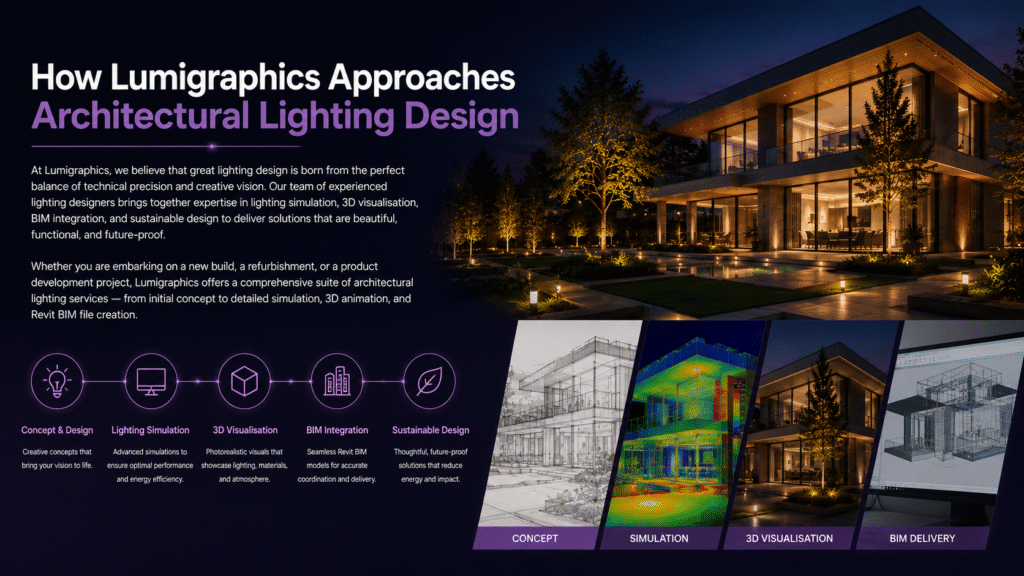
At Lumigraphics, we believe that great lighting design is born from the perfect balance of technical precision and creative vision. Our team of experienced lighting designers brings together expertise in lighting simulation, 3D visualisation, BIM integration, and sustainable design to deliver solutions that are beautiful, functional, and future-proof.
Whether you are embarking on a new build, a refurbishment, or a product development project, Lumigraphics offers a comprehensive suite of architectural lighting services — from initial concept to detailed simulation, 3D animation, and Revit BIM file creation.
Conclusion
Architectural lighting design is not a luxury — it is a fundamental component of great architecture. In 2026, as buildings become smarter, more sustainable, and more human-centred, the role of the lighting designer has never been more critical. Whether you are designing a world-class hotel, a cutting-edge office, or a beautiful home, investing in professional lighting design pays dividends in aesthetics, energy efficiency, well-being, and commercial performance.
Ready to transform your next project with the power of light? Contact the Lumigraphics team today for a free consultation.